

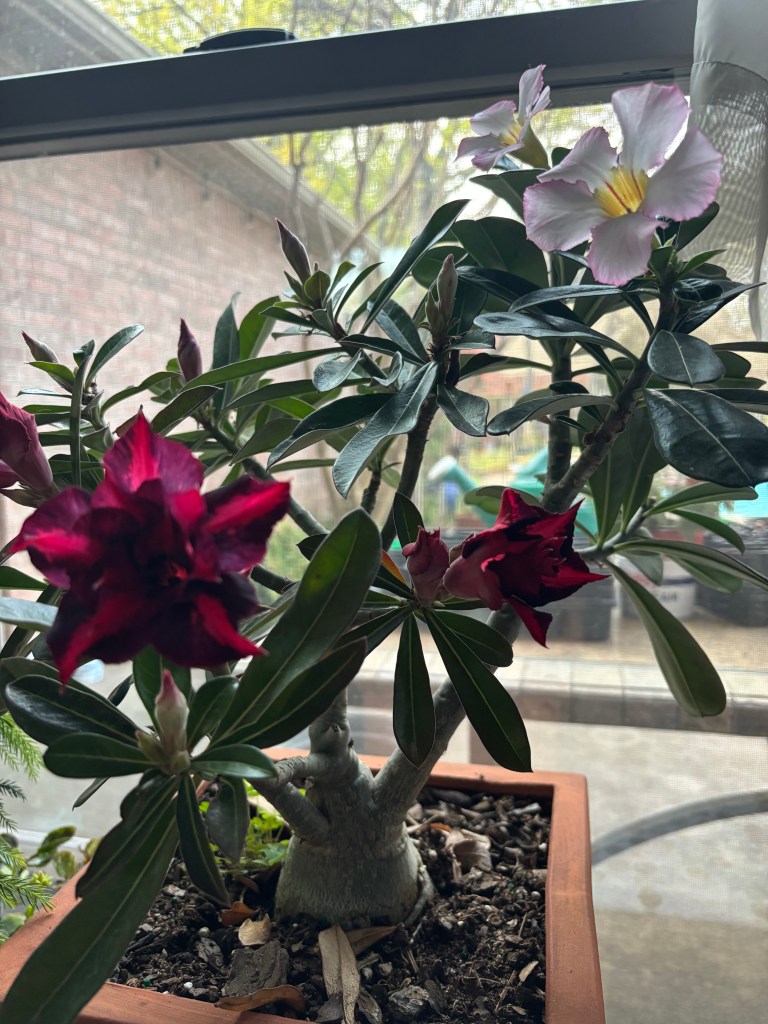
Two years ago, I saw a Desert Rose in my local garden center and fell in love. It is such a funky plant, with a fat caudex (water-storing trunk) and beautiful, large, long-lasting flowers that bloom in both spring and fall (after resting during the hottest part of the summer). It is one of the few plants for me with the extra special designation: non-native plants that are so beloved that they are worth the trouble of bringing them inside for the winter and back outside for the summer.
I was thrilled that it put out seeds its first year with me (surprise!). I happily collected them and planted them in seed trays (in my oven with the light on to keep them toasty warm and moist until germinating). Out of about 50-something seeds, about 20 seeds sprouted. Out of those, 3 became viable and finally now (two years after sowing the seeds) I have 2 strong and healthy small plants (yay Nature for hurling out an abundance of seeds to make a very few new plants! She’s not worried about “failure”). I am wondering what color the flowers on the new plants will be – because the parent plant is apparently having an identity crisis.
Yes, I know, the actual reason the flowers are two different colors is because the nursery grafted two different plants together and the rootstock is putting out its own trunk with its own flowers and the baby plants will probably have the rootstock color. Some people would cut the rootstock branches off the parent plant to keep only the grafted (desired)color…blah blah blah. Forget that for a moment and listen to the plant.
I personally love that this plant shows both sets of flowers. I love the humble simplicity of the pale pink ones, calm and uncluttered. And I love the sensual arrogance of the purple and red striped ones, boasting frilly double blossoms drenched in deep, robust color. But most of all, I love that the plant can be both at the same time.
It doesn’t have to purify itself.
It doesn’t have to pick a side.
It doesn’t have to be singular in its presentation or align itself with any one way of being.
It doesn’t have to be particularly consistent with its behavior. It can be both simple and ostentatious, aloof and flirtatious.
The multiple attributes of its nature are unified in one plant. Sure, it’s a human-manipulated unity, but the plant is amazing in that it can hold both together. It can keep its dualities without watering either of them down. And it shows both of those to the world with no shame and no regrets.
It’s not a crisis at all.
 Creative Practices